



When you look up at the night sky, it is full of glittering stars. But how can you tell which one is the brightest? Astronomers find out this fact by examining various factors such as a star's apparent magnitude, temperature, proximity, and more.
If you want to discover which star is the brightest, you are in the right place. In this blog, we'll uncover the star that has captured the attention of astronomers as the brightest through the ages.
Sirius Is The Brightest Star In The Night Sky:
Sirius stands out from other stars because of its exceptional brightness. It is relatively close to Earth as it is located 8.6 light years away from it. This star is also known as the Dog Star and holds great significance in scientific studies. During winter, you can easily spot it in the Northern Hemisphere.
Astronomical Details Of Sirius

Now that you know Sirius is the brightest star in the sky, let's explore its different astronomical aspects.
➤ Binary Star System
About 300 millions years old, Sirius is a binary star system and has two stars that orbit around their center of mass. These orbits are because of their gravitational attraction. General classification of these two stars is:
Sirius A: It is the main sequence star and a brighter component. It has a surface temperature of 9940 Kelvin and is a relatively younger star.
Sirius B: It is a companion star which is also known as a faint dwarf. It is much smaller and denser as compared to Sirius A. According to NASA, it is 10,000 times dimmer than Sirius A. This star was first observed in 1862 by Alvan Graham Clark through a very careful observation.
➤ Stellar Evolution
Both of the stars have different evolutionary paths. Let’s discuss them:
Sirius A: It evolved as a cloud of dust and gas. It involves the fusion of hydrogen into helium in the core and shines as the brightest star. It is expected that it will turn into a red giant star in the future after using all its hydrogen fuel.
Sirius B: Its composition includes carbon and oxygen and has great density. At the time of birth, it was similar to Sirius A. In the future, when the fusion ends, it will turn into a cold object and will be known as a black dwarf.
Why Is Sirius The Brightest Star In The Night Sky?
Following are the factors that influence the brightness of Sirius. Let’s have a look at them:
➤ Color
Sirius appears bright in the sky because of its blue-white color. Stars that emit light in these wavelengths tend to appear brighter than those that emit yellow or red wavelengths.
➤ Proximity
Another key factor that contributes to the brightness of Sirius is its proximity. As it is the closest star to Earth, it appears brighter as compared to other stars.
➤ Twinkling Effect
Sirius has a twinkling effect because of atmospheric turbulence. When the light refracts towards our eyes, the star tends to appear brighter. On the other hand, when the light refracts away, other stars usually become dimmer. But, the brightness of Sirius remains consistent because of its luminosity.
➤ Magnitude
If a star has a lower magnitude, it appears brighter from the Earth. Because Sirius has an apparent magnitude of only -1.46, this is one of the reasons that it appears as the brightest star in the sky.
Other Notable Bright Stars
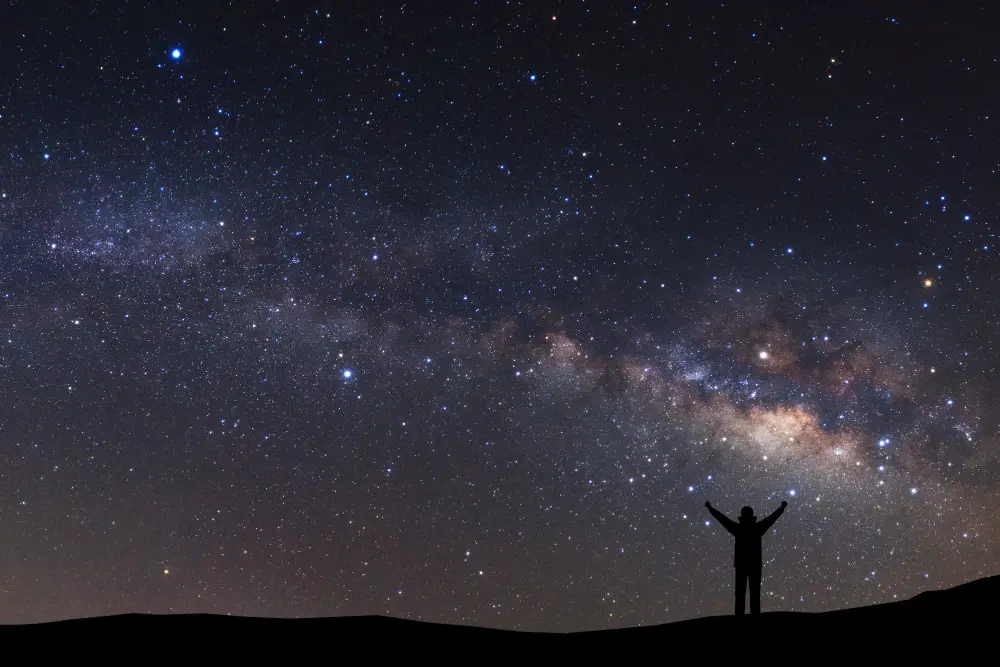
Apart from Sirius, there are some other notable bright stars as well. Let’s have a look at them in detail:
★ Canopus
After Sirius, Canopus is the brightest star in the sky, also known as Alpha Carinae. It is a supergiant star located in the southern celestial hemisphere, 310 light years away from the Earth.
It is one of the significant navigational stars and has a great honor in human history. In the absence of visible landmarks, this star is always used to navigate vast oceans. Moreover, it holds great importance for astronomers as it provides insights about the processes of stellar evolution and helps to detect planets around other stars.
★ Alpha Centauri
Alpha Centauri has three stars which are:
- Alpha Centauri A – Larger And Brighter
- Alpha Centauri B – Smaller And Cooler
- Proxima Centauri – Red Dwarf Star
This star system has great significance in the search for exoplanets. It provides information about the habitability of planets around low-mass stars like red dwarfs. Apart from exoplanets, it helps in useful discoveries of many other stellar and planetary systems.
★ Arcturus
In terms of brightness, Arcturus comes at fourth number and its luminosity is much greater as compared to the Sun. It is 36.7 light years away from the Earth and has a peculiar motion in space. This star appears orange-red in color and its temperature is quite low as compared to the Sun.
As this star is prominent in the Northern Hemisphere, it plays a great role in determining the direction of ships and seasonal changes. Moreover, it acts as a subject of fascination in different cultural poems.
Quick Comparison Of Sirius’s Brightness With Other Stars
Just take a look below to see a brief comparison of the brightness of Sirius with other stars:
- Sirius is 25 times brighter than the Sun.
- Its brightness is twice as bright as Canopus.
- It is 7.5 times brighter than Vega.
- Sirius is 4 times brighter than Alpha Centauri A.
- It is 22 times brighter than Procyon.
Conclusion
Now you know that Sirius is the brightest star in the night sky. Its blue-white color, proximity to Earth, and low magnitude make it shine the brightest. The star's fascinating binary system and stellar evolution add to its significance in astronomy. While stars like Canopus, Alpha Centauri, and Arcturus are also bright, Sirius stands out the most. Next time you gaze at the night sky, try spotting Sirius and explore more about its wonders.
Ready to capture your special moment?
Create Your Star Map →