


The Hubble Space Telescope was launched in 1990 and has become one of the most important astronomical tools for scientists. The telescope is named after the famous astronomer Edwin Hubble. It has been used to study distant stars, galaxies, and other celestial objects in the universe. One of the most important programs of the Hubble Space Telescope is the Hubble Deep Space program.
The Hubble Deep Space program is a project that uses the telescope; its used to research and observe some of the most distant and faint objects in the universe. This includes studying the early universe, the formation of galaxies, and the discovery of new stars and planets. The telescope is able to observe and study objects by looking at the faint light that has been travelling for billions of years to reach us. This light is called the Cosmic Microwave Background radiation, it is essentially the afterglow of the Big Bang.
The telescope's main instrument for the program is the Advanced Camera for Surveys (ACS) which was installed in 2002. This camera allows the telescope to take wide-field and high-resolution images. This has helped scientists study distant universe further than before in great detail. The telescope also uses other tools such as the Wide Field Camera 3 (WFC3) and the Cosmic Origins Spectrograph (COS).
A Core Sample of the Universe
If you want to discover a whole universe in a tiny dot, the Hubble Deep program can help you do that. It is a revolutionary method of studying the universe, where instead of scanning vast swathes of sky, the telescope focuses on tiny and seemingly empty patches of space.
By capturing the faint light from galaxies located billions of light-years away, the Hubble telescope offers a "snapshot" of the universe as it was in its infancy. With this “core sample”, astronomers can study the early stages of galaxies and track the universe’s growth over time. These images are essential for understanding the fundamental processes that have shaped the universe we see today.
Hubble Deep Field South
Following the success of the first Deep Field, astronomers considered capturing the Hubble Deep Field South. That is why they pointed the telescope to the southern skies. This new view showed a different selection of galaxies. It revealed many variations in galaxy shapes and sizes. It expanded our cosmic understanding by exploring a new region.
Hubble Ultra Deep Field
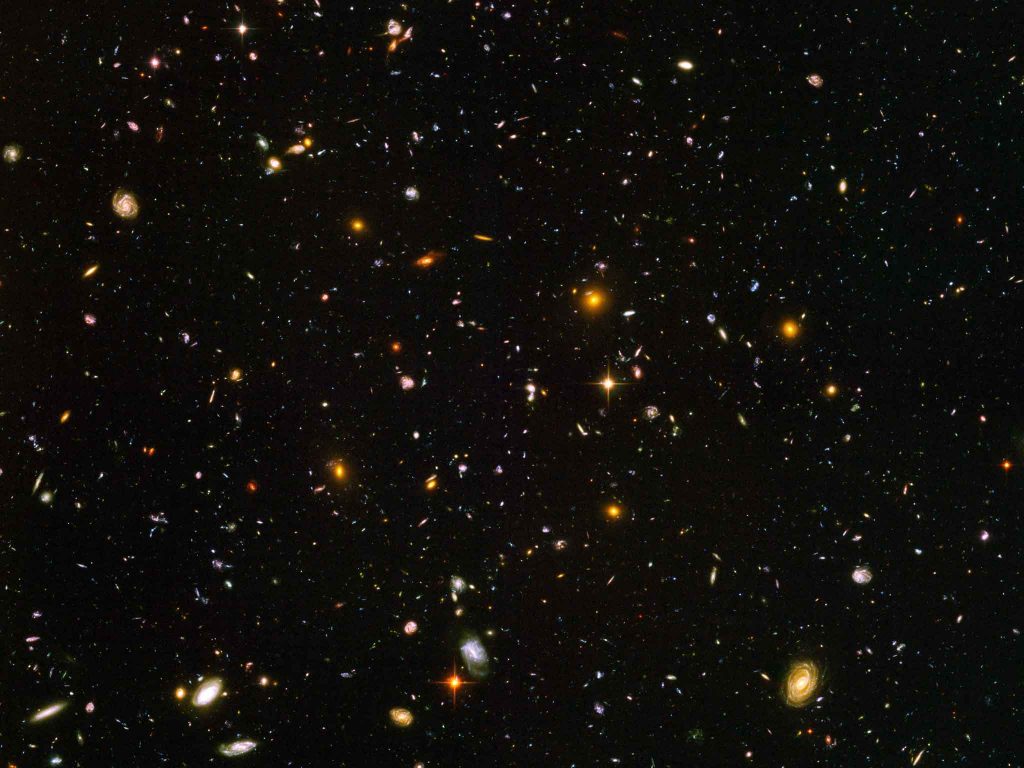
The Hubble Ultra Deep Field is another record-breaking image. It captures galaxies whose light has travelled for more than 13 billion years. That is nearly the beginning of the universe itself. This image allows us to witness how the earliest galaxies formed when the cosmos was only a few hundred million years old.
Hubble Ultra Deep Field-Infrared
The Hubble Ultra Deep Field-Infrared looks at light invisible to the human eye. So, it helped scientists to peer through cosmic dust and see even more distant galaxies. This infrared view uncovers the building blocks of galaxies hidden behind clouds of gas and dust.
Hubble eXtreme Deep Field
The Hubble eXtreme Deep Field combines years of data into the most detailed image. It shows tiny and faint galaxies that give clues about the universe’s first stars and the conditions that shaped everything we see today.
Discoveries by the Hubble Deep Space Program
Hubble Deep Space program has made some significant discoveries such as the proof of dark energy. Scientists used the telescope to study distant supernovae; this lead to evidence that the universe is expanding at an accelerating rate. This discovery was made possible by studying the high-resolution images taken by the telescope. It has allowed us to have a better understanding of the nature of the universe.
Another important discovery is being able to study the early universe. The telescope has been able to observe the light from distant galaxies. This light has been travelling for billions of years to reach us; so it acts like window into the past. This has allowed scientists to study the formation and evolution of galaxies in the early universe.
The Hubble Deep Space program has also been used to study the formation of stars and planets. The telescope has studied the light emitted from young stars and protoplanetary disks. Scientists now have a better understand of the process in how stars and planets form.
Conclusion
The Hubble Deep Space program is an ongoing project that uses the Hubble Space Telescope. It’s mission is to study some of the most distant and faint objects in the universe. The program has led to important discoveries such as the evidence of dark energy. It has also been able to study the early universe using light. The telescope's main instrument is the Advanced Camera for Surveys. It also uses a Wide Field Camera 3 and the Cosmic Origins Spectrograph. These tools have supplied high resolution images that have enabled scientists to study the universe in great detail. The program is highly impressive in how it continues to provide valuable information and insights into the nature of the universe. We can’t even imagine what many more exciting discoveries the telescope will find in the future.
FAQs
What is the extreme deep field Hubble?
It’s the deepest and most detailed image from the Hubble Telescope. It shows the faintest and most distant galaxies ever seen.
What did the famous Hubble Deep Space Telescope Field tell us?
It revealed that the universe is full of galaxies at various stages of evolution. It helped us understand how galaxies grow and change over billions of years.
What was the purpose of the Hubble Deep Field experiment?
The goal was to capture an ultra-clear image of a small patch of empty sky to study distant galaxies and the early universe.
Is the Hubble Deep Field image real?
The Hubble Deep Field Image is real. It’s created from multiple long exposures of deep space taken by the Hubble Telescope, which are combined to form a detailed and authentic image.
How many light-years away can the Hubble telescope see?
The Hubble Telescope can observe galaxies over 13 billion light-years away.
Ready to capture your special moment?
Create Your Star Map →