


Want to know more about Picture the stars' new Deep Space Hubble Prints? Well here is everything you will need to know about NASA's Eagle Nebula – Pillars of Creation.
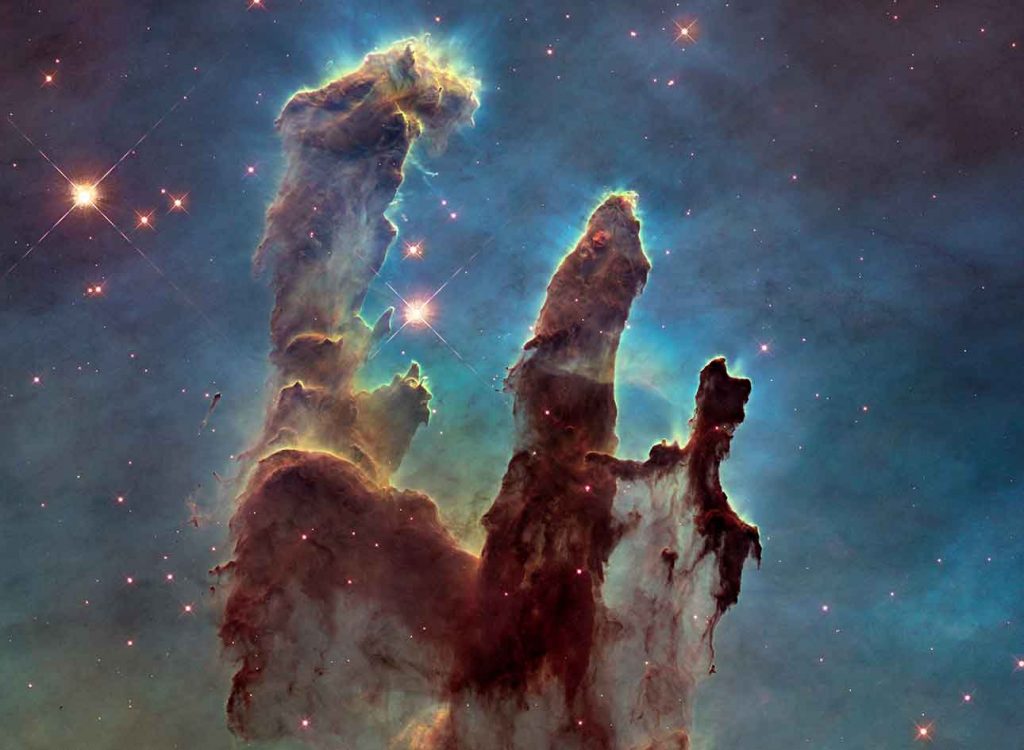
Our first Print is the Pillars of creation Located in the Eagles Nebula. One of Hubble's most favoured images. Liked so much that it was revisited twice, first in 1995 only 5 years after the Hubble Telescope was launched and again 20 years later to mark its 25th anniversary in orbit.
The Eagles Nebula, also known as Messier 16 or M16 discovered by the Swiss Astronomer Jean-Phillipe Loys de Cheseaux in 1745 is located 7000 Light Years from Earth (or 2000 Parsecs for the sci-fi buffs out there) and can be measured at a whopping 70 by 55 Light Years. M16 is located in the Constellation Serpens, one of the 48 constellations listed by the Greek astronomer Ptolemy in the second century.
Observing the Pillars of Creation
You can only observe the Pillars of Creation Nebula if you have the right equipment. It is impossible to spot them with the naked eye as they are 6,500 light-years away from Earth in the constellation Serpens.
Experienced stargazers sometimes see the region's faint outline when they have dark skies and powerful telescopes. It takes patience, though.
If you are using a large backyard telescope, try pointing it at Serpens during the summer months when it sits higher up. The nebula stays dim but your chances of observation improve.
Photographing the Pillars of Creation
NASA's Hubble Space Telescope captured the original photo of the Eagle Nebula pillars of creation in 1995. It showed massive columns of gas and dust. Each one stretched several light-years high. What made it special wasn't just the massive scale but the dark shapes that mark the birthplaces of new stars.
Since then, both the Hubble and James Webb Space Telescopes have captured new images. These updated pictures use infrared and advanced imaging to pierce through the dust and reveal what hides behind and inside the pillars.
Today's astrophotographers attempt to capture this identical scene through long exposure and stacked images. But to match NASA's level of clarity, high-altitude observatories or space-based instruments are also essential in addition to a backyard telescope, though.
Conspiracy Theory: Are the Pillars of Creation Destroyed?
Since the nebula sits 6,500 light-years away, we won't know for certain if these pillars exist until light from that event reaches Earth.
Currently, the Pillars of Creation in the Eagle Nebula still show up in images from space telescopes. This means they remain there from our perspective. If something has changed, we'll only witness it in the future.
At present, they are still considered one of the most remarkable star-forming regions in space
How The Pillars of Creation Is Formed
Within NASA's Eagle Nebula you will find The Pillars of Creation, the three towering pillars of gas and dust that resemble Buttes in the Desert, an easily identifiable feature in this visually stunning image. These pillars are a part of an active star forming region that hides its newborn stars throughout the columns. These dense clouds are made up of Molecular Hydrogen Gas and Dust that have survived much longer than their surroundings.
The newborn stars give off ultraviolet light and it is this process of high energy radiation that causes changes in substances it hits known as photoevaporation. This phenomenon causes the pillars to break down slowly, ultimately revealing tiny globules of even denser gas buried within them. These Globules are known as evaporating gaseous globules or EGG’s! Within these EGG’s embryonic stars form inside that then abruptly stop growing when they are uncovered, separating them from the larger cluster of gas they were drawing mass. These stars eventually emerge from the EGG’s.
The Pillars of creation changed the model of star formation which was used by astronomers to identify more accurate counts of newly formed stars as well the quantities of Gas and Dust within the gas and dust in the region. Slowly but surely, they will begin to build a clearer understanding of how stars are formed and burst out of these dusty clouds over millions of years.
How To See The Eagle Nebula
With an apparent Magnitude of 6, this means it is barely visible to the naked eye. The Eagles Nebula can be viewed with a small telescope, for the best viewing conditions it would be best to do this within the month of July. To view the Pillars of creation a much larger telescope and optimal viewing conditions would be required. If you would like to know more on how to set yourself up for stargazing check out our blogs on 5 tips for stargazing and 8 Essentials items to take star gazing.
FAQs
What nebula are the Pillars of Creation part of?
They are part of the Eagle Nebula which is also known as Messier 16 or M16.
Are the Pillars of Creation in the Carina Nebula?
The Pillars of Creation nebula is found in the Eagle Nebula, not the Carina Nebula. These are two separate regions of space.
Can you see the Pillars of Creation with a telescope?
They are very difficult to see through small telescopes. However, with dark skies and high-powered equipment, experienced astronomers can spot part of the Eagle Nebula.
To get your copy of the Eagle Nebula's – Pillars of Creation click here
Ready to capture your special moment?
Create Your Star Map →