


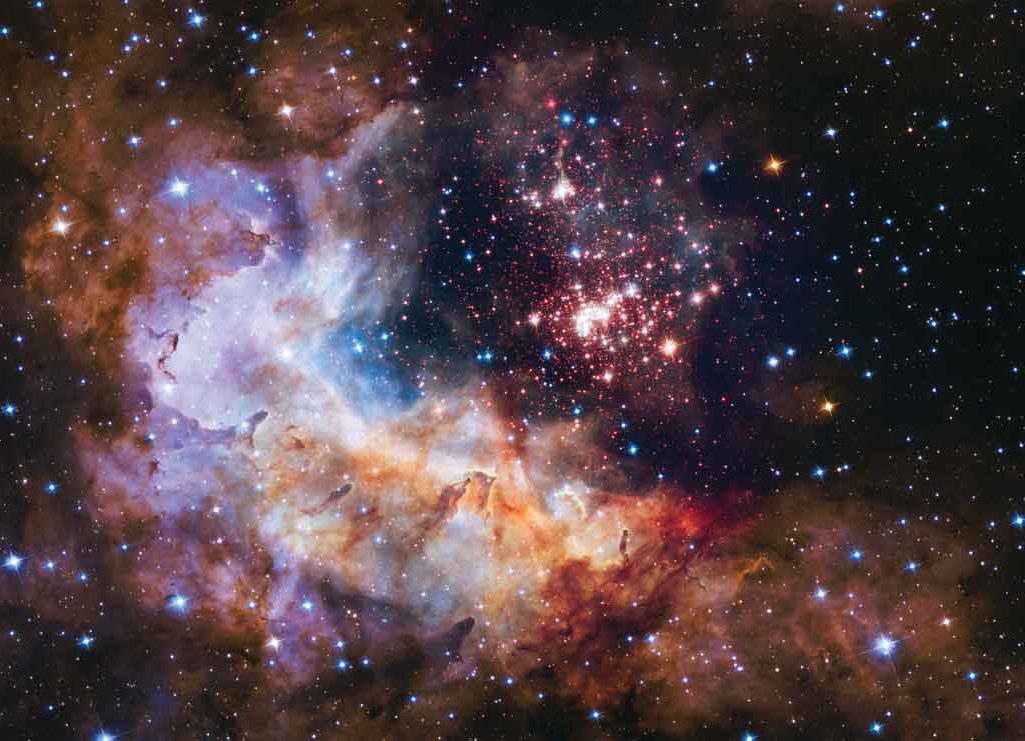
This stunning image was chosen to celebrate NASA's Hubble 25th Anniversary of the space telescope’s silver anniversary in space. What better way than to show off some of space's own made fireworks!
This massive cluster of around 3,000 stars is called Westerlund 2, after it's namesake the Swedish Astronomer Bengt Westerlund who discovered the stars in the 1960’s. The cluster exists in a harsh stellar nursery known as Gum 29, located 20,000 lightyears away from the Earth in the Constellation Carina.
How The NASA's Hubble 25th Anniversary Image Is Made
Hubble pierced through a dusty veil shrouding the stellar breeding ground near-infrared light using the Hubble’s Wide Field Camera 3, this provided a clear view for astronomers of the nebula and the dense population of stars in the central cluster. This cluster measures between 6 to 13 light-years across.
The colossal array is only about 2 million years old and contains some of our galaxy’s most hottest, radiant and massive stars. Some of its biggest stars release a cascade of ultraviolet light and hurricane-force winds of charged particles that etch at the enveloping hydrogen gas.
The nebula reveals a wonderland landscape of valleys, buttes and oceanic structures. The buttes composed of dense gas and considered to be incubators of newborn stars, are a few lightyears tall and point to the centre star cluster. Other dense regions surround the buttes, containing reddy-brown threads of gas and dust. These red colours represent hydrogen within the cluster.
With the cluster being considerably young, in astronomical terms – 1 to 2 million years being considered young. It hasn't yet had the opportunity to disperse its stars deep into interstellar space, providing astronomers with the brilliant opportunity to gather crucial information on how these clusters are formed by observing it within its star-birthing environment. The blue stars viewed in this image are majorly foreground stars much closer to earth, the bluish hue these stars give off, predominantly represents oxygen.
This image was named Celestial Fireworks due to its natural resemblance to a monumental fireworks display for all to enjoy.
To get your copy of the The Hubble 25th Anniversary image click here
Westerlund 2 – Hubble 25th Anniversary Image
For Hubble’s 25th birthday, NASA shared a photo of a star cluster called Westerlund 2. It is about 20,000 light-years away in the Carina constellation. Hubble used special cameras and infrared light to take this picture. That helped it see through the space dust.
In the photo, you can see over 3,000 young stars, a part of space called Gum 29. Some of these stars are only 1 to 2 million years old. They are very hot and send out strong winds and light. These winds shape the gas around them into tall towers and ridges. The view looks like fireworks in space, which makes this photo both beautiful and important for science.
The Pillars of Creation
The Pillars of Creation are in the Eagle Nebula. They are huge clouds made of gas and dust, and new stars are forming inside them. Light from these young stars nearby makes the clouds glow, and winds from these stars also change the shape of the clouds.
Hubble took a new and clearer photo of the Pillars. It shows more details than before. This helps scientists learn how stars are born and how they change the space around them. It is one of Hubble’s most famous pictures.
Galaxies Galore
Hubble’s Ultra Deep Field is one of the deepest space images ever taken. In just one picture, you can see nearly 10,000 galaxies. Some of these galaxies are over 13 billion years old. These galaxies come in different shapes, sizes, and colors. Some look red and old, while others are bright and spiral-shaped.
This picture helps scientists study how galaxies form and how the universe has changed over time. It is one of Hubble’s greatest discoveries.
The Sombrero Galaxy
The Sombrero Galaxy, or M104, is 28 million light-years away. It looks like a hat because it has a bright center, dark dust around it, and a glowing ring of stars.
Hubble took a very detailed photo of this galaxy that shows over 800 billion stars. This helps scientists understand how spiral galaxies form and grow.
NGC 3603 – A Busy Star-Making Area
NGC 3603 is one of the busiest places in our galaxy for making stars. It has big, hot, blue stars that were born about one million years ago. These stars give off strong light and winds. This pushes the gas around them and changes how the area looks. By studying this place, scientists can learn more about the process of generating new stars.
Frequently Asked Questions
How does Hubble take photos?
Hubble has cameras that can see different kinds of light, like visible, ultraviolet, and near-infrared. It takes black-and-white photos using color filters. Scientists then combine them to make full-color images.
How long will Hubble work?
Hubble was launched in 1990. It should keep working into the late 2020s. It still works well and is used along with newer telescopes like the James Webb.
Can I use Hubble’s images?
Hubble’s images are free to use. NASA and ESA let people download and share them. Just give proper credit.
Why were early Hubble images blurry?
At first, Hubble’s mirror had a small mistake. This made the photos blurry. In 1993, astronauts fixed it by adding new lenses to it. After that, Hubble started taking clearer and sharper images.
Why are Hubble’s photos black and white?
Hubble takes black and white pictures through different filters. Each filter captures a different type of light. Scientists add color later to show details that our eyes cannot see naturally.
Ready to capture your special moment?
Create Your Star Map →