


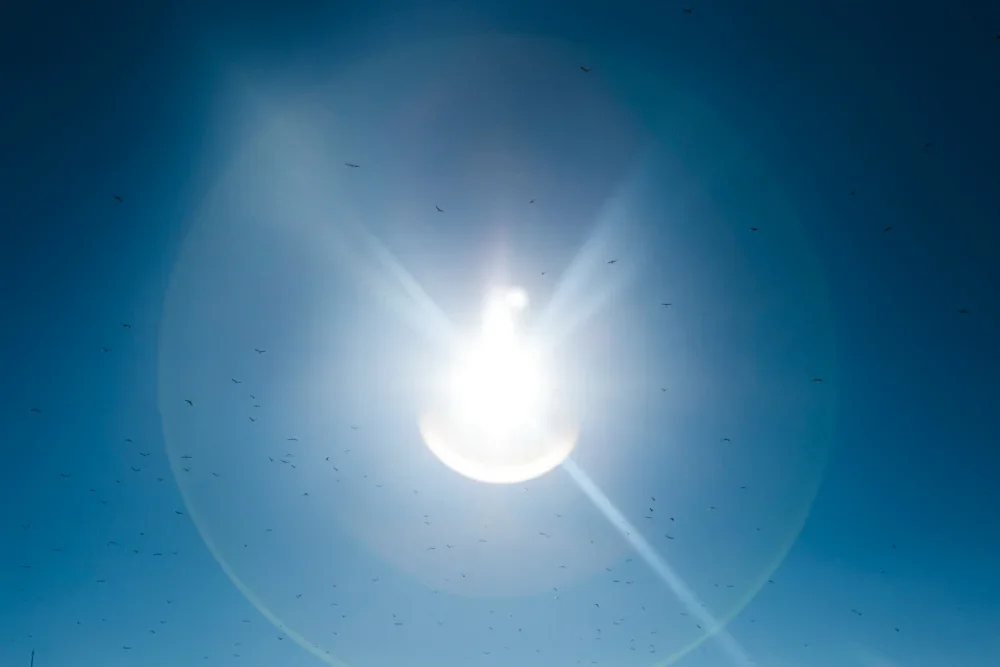
When you gaze up at the night sky, have you ever wondered about the ring of light around the moon? This sight is a moon halo, and it has always cast spellbinding magic on the sky. This sight has fascinated observers for centuries. In this article, we will explore the secrets behind its captivating beauty.
What Is A Moon Halo?
It is actually a luminous ring that encircles the moon. It appears as a soft, diffuse glow and does not have a sharp outline. There are tiny prisms known as ice crystals in the Earth’s atmosphere. When moonlight interacts with them, it results in the formation of the moon halo. Depending on atmospheric conditions, these halos can appear smaller or larger.
Types Of Lunar Halo Moon
Ice crystals have different types and orientations. Because of this, moon halos also vary in type. Let’s take a look at the types of lunar halo moon:
1. 22 Degree Halo
This is the most common type of moon halo, and observing it is a very beautiful experience. It forms a circle around the moon with a radius of approximately 22 degrees. Depending on different atmospheric conditions, it can be faint or colorful. Moreover, its color and brightness depend on the size and shape of ice crystals involved in its formation.
2. Circumzenithal Halo
It is another captivating, atmospheric phenomenon and is quite a rare halo. It appears as an arc above the moon and mostly resembles an upside-down rainbow. This type of halo has vivid colors and appears to be very bright. Usually, the colors range from red on the inside to blue on the outside.
But remember, this phenomenon occurs only when the moon is relatively high in the sky and is one of the most beautiful natural wonders of the atmosphere.
3. Moon Dogs
Moon dogs usually appear as bright spots on either side of the moon and are also known as paraselenae. These bright spots form a ring around the moon and are sometimes mistaken for extra moons because of their extreme brightness. These types of halos are more common during colder months and are quite memorable events for skywatchers.
4. Supralateral Arc
This is also quite a special event as the distinctive arc of light extends horizontally from the moon. It usually forms above 22 degree halo and runs parallel to it but at a higher angle. Because of its unique geometric and atmospheric conditions, this arc is quite rare and provides deep insights into atmospheric optics.
5. Parry Arc
This arc appears as a white or faint arc that extends outwards from the moon. It usually occurs when the moon refracts through column-shaped ice crystals in the atmosphere.
In the early 19th century, a British explorer named Sir William Edward Parry observed and documented this arc, and hence, it was named after him.
What is the Science Behind Moon Halo? Exploring Different Factors
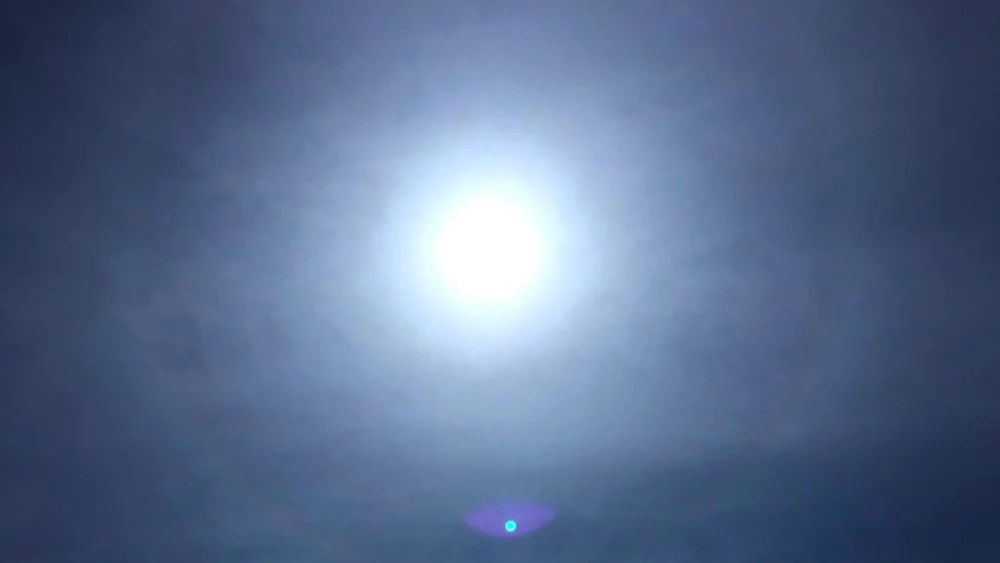
Moon halos are an intriguing optical phenomenon with a deep scientific explanation. Let us discuss it in detail:
✳ Formation Of Ice Crystals
Ice crystals play a great role in the formation of moon halos. They are usually hexagonal in shape and have different sizes. They have a specific orientation of the long axis, and this orientation determines the angle for refraction and dispersion of light, which creates halos.
✳ Refraction
When moonlight interacts with these ice crystals, it undergoes refraction. Refraction is actually the bending of light from air to ice crystals and then back to air. Because of the hexagonal shape and orientation of ice crystals, incoming light bends at specific angles. This bending of light determines the shape and type of halo. For example, if it refracts at 22 degrees from the moon's direction, it results in the formation of a 22-degree halo.
✳ Angular Dispersion
Angular dispersion plays a great role in shaping the moon halos because it separates the different wavelengths of light as it refracts through ice crystals in the atmosphere. This angular dispersion is also the main cause of specific sequences of colors in a moon halo.
✳ Internal Reflection
When light enters into one side of an ice crystal, it refracts and internally reflects several times before exiting at another side. This internal reflection creates the halo effect by scattering light.
✳ Coloration
Moon halos display a range of colors because shorter wavelengths, like blue, are refracted more than longer wavelengths, such as red. This dispersion of light creates a spectrum of hues visible in the halo phenomenon.
What Is The Impact Of Weather on Halos Around The Moon?
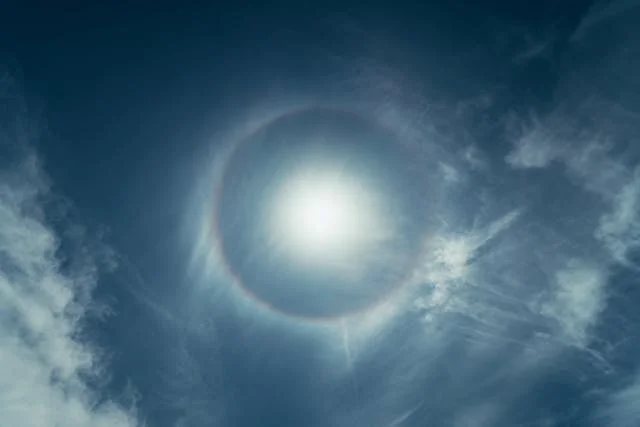
Weather plays a great role in the formation and visibility of moon halos. Let’s throw light on different weather factors affecting the lunar halos:
Presence of Ice Crystals
If ice crystals are present in the upper atmosphere, only then can moon halos form.
Temperature
The formation and suspension of ice crystals require extremely low temperatures in the upper atmosphere. If the temperature is extremely high, crystals may not form or they melt quickly and diminish the visibility of moon halos.
Cloudy Sky
Clouds in the sky obstruct the visibility of the moon, making it impossible to observe any halo effect. Therefore, clear skies are always preferable for viewing the halo phenomenon.
Wind Conditions
As wind can affect the distribution and movement of ice crystals, strong winds can disperse the ice crystals and distort the moon halos.
Air Pollution
In areas where air pollution is very high, there is very less visibility of moon halos. So, you can only observe them in clean environments.
Conclusion
In short, moon halos are beautiful optical phenomena of nature and remind all observers of the stunning ways in which light interacts in the atmosphere. Each type of halo moon discussed above reflects unique atmospheric conditions. Factors like temperature, wind, and air pollution greatly influence their formation and visibility. Moreover, clear, cold nights are the best times to observe these mesmerizing natural phenomena.
Ready to capture your special moment?
Create Your Star Map →