





The Science
The Science Behind Moon Phase Prints
Our Moon Phase Prints are the most accurate depiction of the moon on a given date and location. Achieving this level of accuracy involves complex astronomical calculations and 3D rendering technology.
Based on accuracy alone, only NASA's Dial a Moon resource matches our level of precision. Our team of astronomers and developers are extremely proud of the product we have created.
1.0 Compounding Complexity
Accurately picturing the moon at a specific time and date from a chosen location in the world is a significant challenge. Various factors such as sun path, shadows, and illumination are influenced by orbit, distance, position, and rotation.
Our team of astronomers and developers are extremely proud of the product we have created. Based on accuracy alone, only NASA's Dial a Moon resource is as accurate.
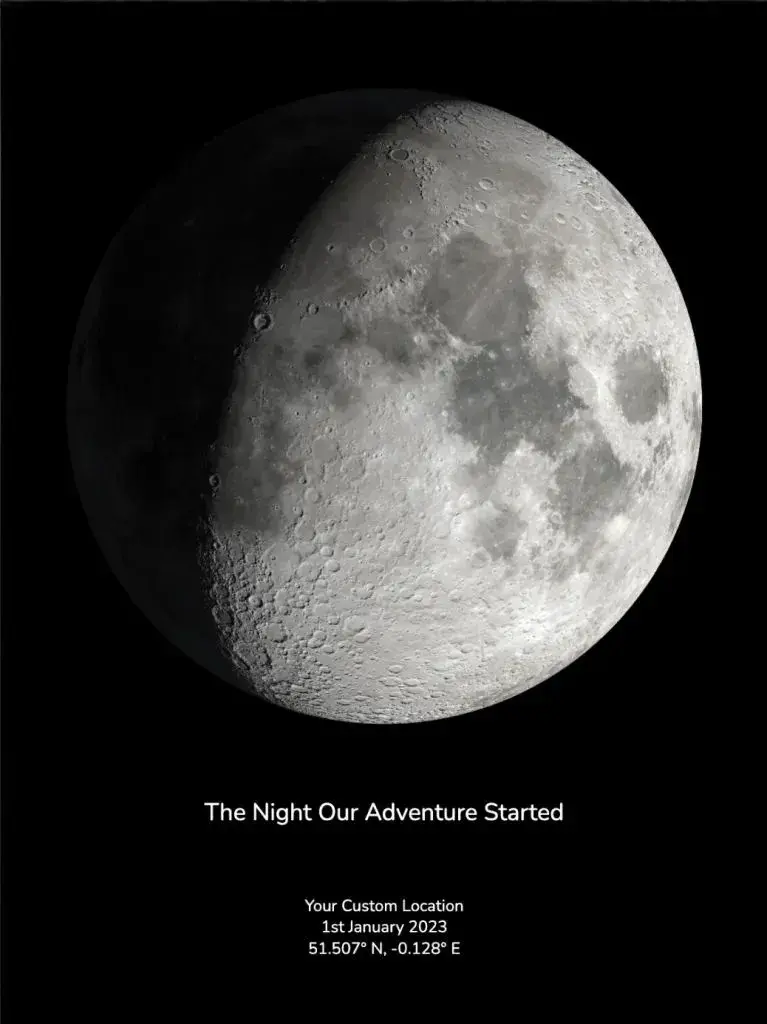
The complex interplay of factors affecting moon phase accuracy
The complexity of these calculations requires advanced 3D rendering and precise astronomical data to ensure your moon phase print represents the exact appearance of the moon on your special date.
1.1 Sun Path
The sun's path is complex as it is determined from an observer on Earth looking at an object (the Moon) whose light source (the Sun) are both moving at different speeds, orbits, and distances.
As such, the moon phase print has to be rendered in 3D, and the shadows can then be accurately calculated and displayed. This three-dimensional approach ensures that the terminator line (the boundary between the illuminated and dark portions of the moon) is positioned correctly.
The angle of the sun relative to both the moon and the observer on Earth varies constantly, requiring precise calculations for each unique date, time, and location combination.
1.2 Illumination
The illumination of the Moon is dynamically affected by its light source, the Sun. The Earth also has an effect on the illumination of the Moon, known as "earthshine".
This effect, though minuscule (<1%), was measurable and calculated in our system. Earthshine is the sunlight that reflects off the Earth's surface and illuminates the dark portion of the moon, giving it a subtle glow that is visible during crescent phases.
Illumination Factors
The moon's brightness varies throughout its cycle. During a full moon, it appears roughly 10 times brighter than a half moon, not just twice as bright. This is due to the way light scatters off the lunar surface at different angles.
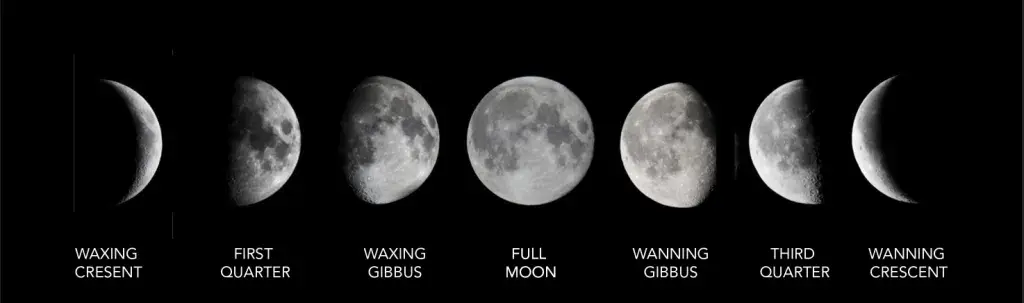
Comparison of moon phases showing illumination differences
1.3 Distance / Orbit
The Moon orbits the Earth in a non-linear way. For example, at the largest orbital deviation (Moon at apogee), the distance is calculated at 252,088 miles away from Earth, and at the smallest orbital distance (Moon at perigee), it is 225,623 miles.
This variation in distance not only affects the visual image of the Moon but also the speed at which the Moon is traveling (faster as its distance towards the Earth reduces).
Apogee Distance
252,088
Miles (Farthest)
Perigee Distance
225,623
Miles (Closest)
Size Variation
12%
Larger at Perigee
Lunar Cycle
29.53
Days per Cycle
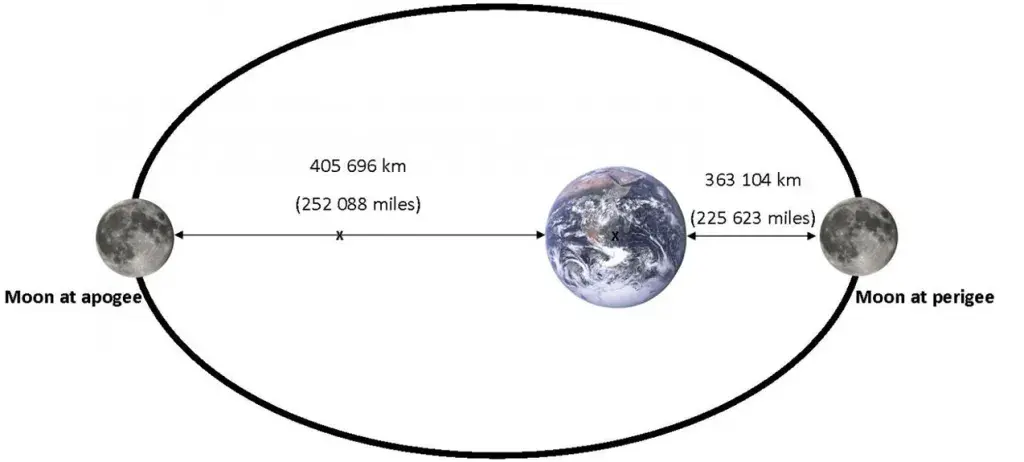
The moon's elliptical orbit showing Apogee and Perigee distances
These orbital variations mean that the moon's appearance can change significantly depending on where it is in its orbit during your chosen date. Our system accounts for these variations to provide the most accurate representation.
1.4 Geographical Coordinates
Geographical coordinates are a system used to specify locations on the Earth's surface. Our systems use Google Maps API to accurately determine this variable; the user can simply search via their postcode, city, or even place name.
Observer Location Matters
The moon's appearance varies slightly depending on your location on Earth. The angle at which you view the moon, and therefore the orientation of its illuminated portion, changes based on your latitude and longitude. Our system calculates these subtle differences to ensure accuracy.
Geographic coordinates based on the Earth's reference ellipsoid provide the precise observer position needed for accurate moon phase calculations. This ensures that your moon print shows exactly what the moon looked like from your specific location.
1.5 Lunar Cycle
For the moon phase print, the orbit of the Moon (the lunar cycle) is very important, ensuring the Moon is pictured at the optimum (culmination) phase/time, meaning the Moon is at its most visible.
The lunar cycle, also known as a lunation, takes approximately 29.53 days to complete. During this time, the moon passes through all of its phases from new moon to full moon and back again.
When you specify a date and location, our system calculates the optimum time when the moon is at its highest point in the sky and most visible from your location. This ensures your moon print captures the moon at its best viewing angle.
The phases of the moon are determined by the relative positions of the sun, Earth, and moon. As the moon orbits Earth, we see different portions of its illuminated half, creating the familiar cycle of phases.
1.6 Moon Size
The Moon at its furthest distance (Apogee) and its shortest distance (Perigee) affects its visual size from Earth. For example, the Moon will appear 12% larger at its Perigee than its Apogee phase.
When the moon is at perigee and full, it is often called a "Supermoon" - a term popularized in recent years to describe this impressive lunar event. The difference in size is noticeable and creates a more dramatic visual effect.
Size Variations
Perigee (Closest)
225,623 miles
Appears 12% larger
Apogee (Farthest)
252,088 miles
Standard size
We display the moon at its largest ratio optimally to the print. However, we can adjust this feature upon request to reflect its actual size based on its position in the lunar cycle on your chosen date.
1.7 3D Rendering Technology
To achieve the level of accuracy required, we don't simply use 2D calculations. Our moon phase prints are generated using advanced 3D rendering technology that models the moon as a three-dimensional sphere.
This allows us to accurately calculate:
- The exact position and angle of the terminator line
- The libration of the moon (the slight wobble that lets us see different edges)
- The precise shadows cast by lunar features
- The correct orientation based on observer location
This 3D approach ensures that every detail of the moon's appearance is calculated with astronomical precision.
1.8 Lunar Surface Details
Our moon phase prints capture not just the phase, but also the intricate details of the lunar surface. The dark areas (maria) and bright highlands are rendered with careful attention to their actual positions and relative brightness.
These surface features help make each moon phase print unique and recognizable, allowing you to see the same familiar face of the moon that appeared on your special date.
Ready to Create Your Own Moon Phase Print?
Capture the exact moon phase from your special moment with our astronomically accurate and beautifully crafted moon prints.
Create Your Moon Phase Print